The Mandalorian™: Adventures - Sworn to the Creed, Interview with Designer Joshua Beppler
The journey through The Mandalorian: Adventures is officially in its final chapter with the release of the Sworn to the Creed expansion. This marks the completion of the games inspired by the hit Disney+ series, bringing players deeper into the events of season three while introducing new characters, missions, and a long-awaited campaign mode.
Designed by Joshua Beppler and Corey Konieczka, the expansion aims to build upon everything that made the previous installments memorable, from cinematic storytelling to accessible yet tactical cooperative gameplay.
For Joshua Beppler, the Sworn to the Creed expansion carries additional significance. As one of the co-designers behind The Mandalorian: Adventures line, this expansion represents one of his final projects with Unexpected Games before moving on to his own next chapter.
We sat down with Josh to discuss the design challenges and triumphs behind Sworn to the Creed, the evolution of the series across its three installments, and what it means to leave behind a game that has become a beloved part of the modern Star Wars™ tabletop landscape.

When you and Corey Konieczka first set out to create The Mandalorian: Adventures, what was the core experience you wanted players to have, and how did that vision evolve over the course of the series?
As massive STAR WARS fans, Corey and I wanted to be sure we were faithful to the source material, but also strove to create an experience that was still highly accessible. Thankfully, The Mandalorian series is a great source for both really fun set pieces to play within and introducing STAR WARS to new audiences.
The Mandalorian: Adventures game series has now covered multiple seasons of the show. Looking back, what do you think the team learned from the base game and earlier expansions that directly influenced the design of the The Mandalorian: Adventures - Sworn to the Creed?
Through the development of both the base game and the Clan of Two expansion, we defined what was possible within the game system while continually talking about what we’d love to see added in the future. It was a blast to see most of these concepts bear fruit in the forms of the characters, campaign mode, and more.
Sworn to the Creed brings the story into season three territory. What aspects of that season were the most exciting, or challenging, to translate into gameplay?
There were a few ideas that always stayed top of mind for us within the Adventures system that actually fit perfectly within the backdrop of season three. For one, a multi-path map with only one correct way through found life within The Mines of Mandalore. Another example can be found in The Droid Problem mercenary mission, where players may use a bit of logic and deduction to win – just as Din Djarin and Bo-Katan Kryze needed to do to figure out who was behind the malfunctioning battle droids.
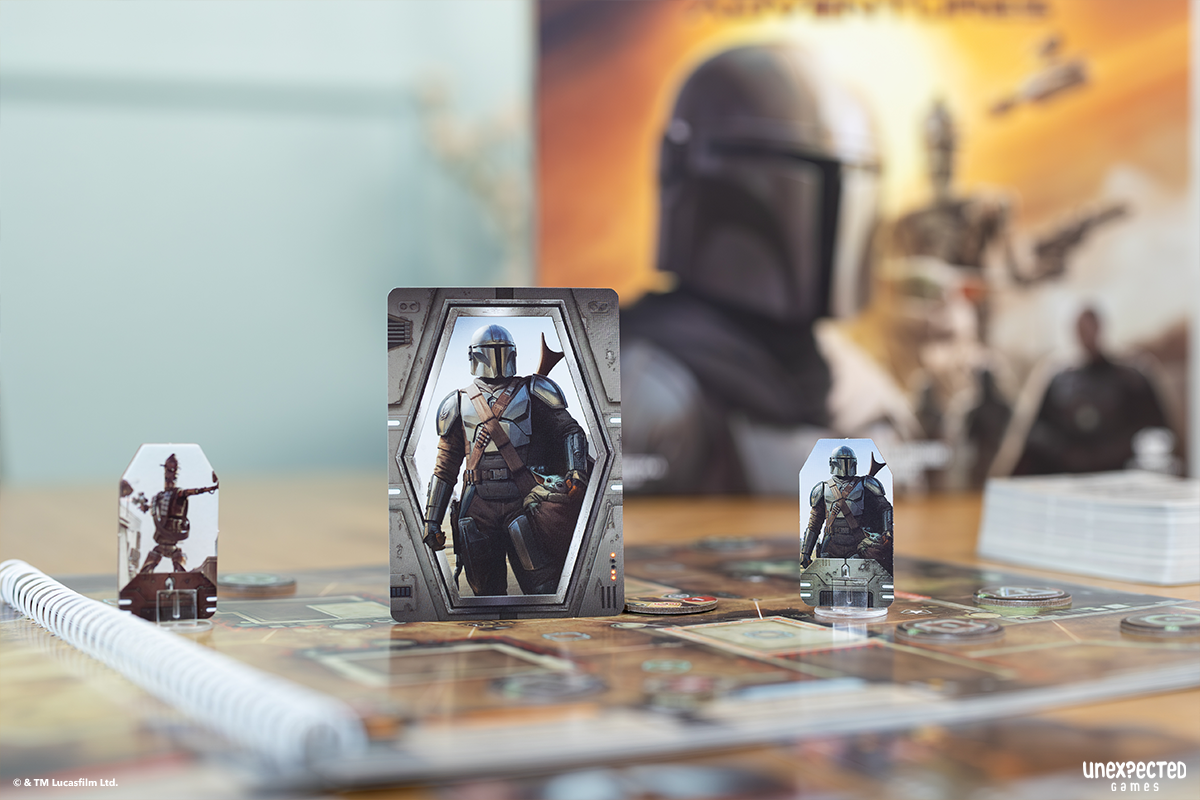
This expansion introduces new characters, including Grogu and The Armorer. When designing playable characters for a cooperative game, how do you make them feel authentic to the characters, while still ensuring each offers a distinct gameplay experience?
Going all the way back to the base game, it’s always been important to boil these characters down to what their defining traits really were. For The Mandalorian, he’s a walking armory with plenty of weapons to handle any situation. In Clan of Two, we gave Fennec Shand the option of longer-range attacks, mirroring her abilities as a sniper.
We approached our characters in Sworn to the Creed in the same way. It felt obvious to center The Armorer’s abilities around our new Equipment deck, but at the same time she’s an incredible support system for her people. She was a prime candidate for the double-sided character abilities, being able to “Forge” equipment through the planning action and then “Supply” other characters with what she was able to produce.
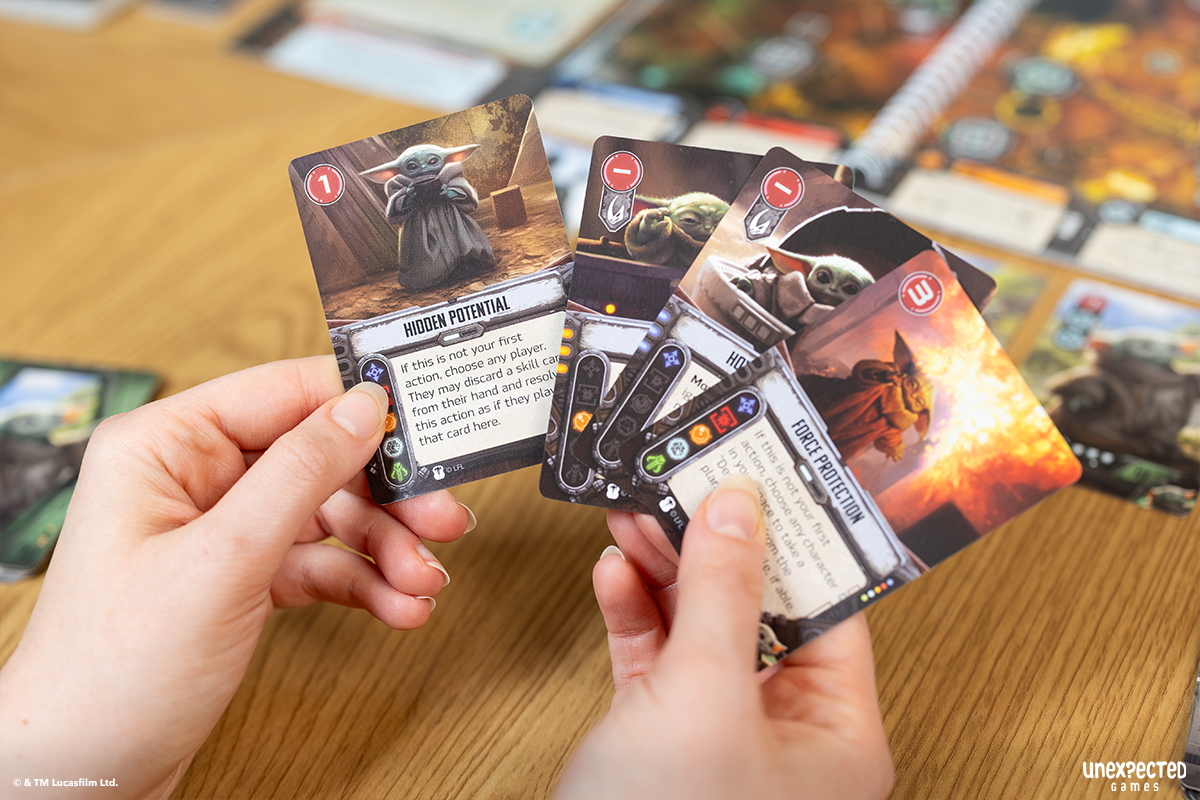
Meanwhile, Grogu has shown flashes of incredible power throughout The Mandalorian series, but always at a great physical cost. It was such a blast to give him the opportunity to have big, impactful turns with a third action when the team needs them most, but needing to flip to his “Sleepy” side afterwards feels like a great example of tying game mechanics to the source material.

One of the headline features is the new campaign mode with character progression. What inspired that addition, and how does it change the overall experience compared to playing standalone missions?
I think it’s fair to say campaign mode has been one of the most requested additions to the game since its announcement! While the base game strove for accessibility, the creative freedom granted by a second expansion meant we could really dive into the concept.
We focused on what aspects of campaign games were most important to us: fail forward, gaining and spending XP, and variability each time you play – and these are the trademark experiences you’ll find in this campaign mode. Map and mission combos are randomized for each session, XP is earned based on wins and losses, and you’ll never find yourself spinning your wheels on a mission that gives you too much trouble.
What’s perhaps most fun, though, is the character progression. Each character begins with all of their tactical cards removed from their deck. You can spend your XP between missions on powerful equipment upgrades, permanent starting planning cards, or the aforementioned tactical cards – but these purchases don’t have to be your character’s cards! Now that we’re up to 16 playable characters (with the Clan of Two expansion), there’s a great chance you’ll never build your character the same way twice. I’m excited to see what kinds of crazy combinations players discover when playing campaign mode!
The series has always balanced accessibility with meaningful tactical decisions. How did you approach adding new challenges and tougher enemies in Sworn to the Creed without losing what made the game approachable in the first place?
Being the second expansion, I knew we could reasonably expect most players to be quite familiar with this system, and thus we could see a few opportunities to push the envelope with enemy abilities. The game also offers a plethora of ways to tinker with the difficulty to best suit your group, so folks can find whatever sweet spot they’re looking for.
New enemy abilities in this expansion are more about changing up the “puzzle” than they are about increasing the general difficulty. High Alert enemies aren’t inherently more dangerous than other enemies and removing that status is as simple as dealing a single damage, but they’ll act much more frequently if left alone; is it more important to deal with them than focusing on your primary objective? What if they’re protected by a Guardian enemy, who prevents damage to all adjacent enemies? Using the intel action to better position the battlefield becomes even more important at times in this expansion. But none of the new additions add a great deal of complexity, meaning players should be able to easily jump in just as they did with the base game and Clan of Two.
You had the opportunity to collaborate with Corey Konieczka, whose Star Wars game portfolio is legendary. What was it like working together on this series, and is there a particular design lesson or moment from that collaboration that stands out to you?
Corey was my favorite designer when I got into board games, so just getting to work with him on a daily basis was pretty incredible. He’s also become a close friend, and thus the experience was so much fun. It was awesome to watch the gears turn as we tinkered with finding the game’s rhythm, and the breakthrough of landing on the action system in its final form was thrilling.
I think the most important lesson I learned from Corey was avoiding rules that fell on the players to remember in real time. We tried to avoid inherent effects that you learned from the rulebook but could easily forget in the heat of an intense turn. Coupled with David Ardila’s stellar graphic design, we landed on a system that I feel is really user-friendly, and does a good job of avoiding the sinking feeling of forgetting a key rule that necessitates rewinding an awesome turn.
As the final expansion, was there anything you felt you absolutely had to include before closing the book on The Mandalorian: Adventures?
Corey and I both wanted to see some form of a campaign in this game, and thus we knew it was something we’d sort out for this expansion. That, and Grogu! As we followed along with Grogu’s growth in the show, it became apparent that he was ready to be his own playable character. What a blast it was to bring him to life in the game!
When longtime fans finish the final mission of Sworn to the Creed, what do you hope they'll remember most about the journey they've taken across the entire The Mandalorian: Adventures line?
I hope they remember that everything is fully replayable! We set out to ensure this game was something that could hit your table again and again, customizable to fit any and all groups. Complexity can be stripped away to make the game extremely beginner-friendly, while a huge variety of difficulties can be added to make it an exceptionally challenging puzzle.
With this expansion, we’ve now accumulated 12 different maps, 12 distinct story missions, and 20 mercenary missions (including what’s available online!), giving players literally hundreds of map and mission combinations to explore. Add in the 16 unique playable characters, and this is a game you can play for years and years to come!

If you could sit down with a group of players experiencing the complete The Mandalorian: Adventures saga (from the base game through Sworn to the Creed) for the very first time, what's one moment or mechanic you'd be especially excited to watch them discover?
During playtesting, there was a 4-player game in which Greef Karga went first and charged into the middle of the map, guns blazing. Greef never got a second turn, as it was tough for the other players to avoid events and the event deck itself was particularly cruel. Greef was defeated and the game ended in the fastest defeat I’ve ever seen. Rather than being frustrated or annoyed, the players all had a great laugh and immediately set up again, all the while conversing about strategy and how they’d take a more measured approach. The Greef player also settled in to how their character can thrive amidst the madness, rather than causing it. This affirmed for us that the puzzely nature of this game provided a great backdrop for characters to provide unique playstyles, and encouraged true cooperation and coordination between players.
Speaking strictly mechanically, it’s always fun to watch players discover the true potential of cards or actions that at face value may seem underwhelming. When a player finds themselves with a Strategize at the exact moment they need an extra action or card draw, or when the realization of just how powerful manipulating the battlefield with Intel can be, both are memorable moments that influence how you approach each and every mission moving forward.
After spending years helping bring this corner of Star Wars to the tabletop, what has been the most rewarding part of seeing players experience these adventures together?
Anything we can do to get families and friends together at the table for a game is rewarding enough, but getting to do so within a franchise that I’ve loved for most of my life is an absolute dream come true. I’ve been indescribably blessed to have been a part of bringing this game to life, and I hope players enjoy it for a long, long time.